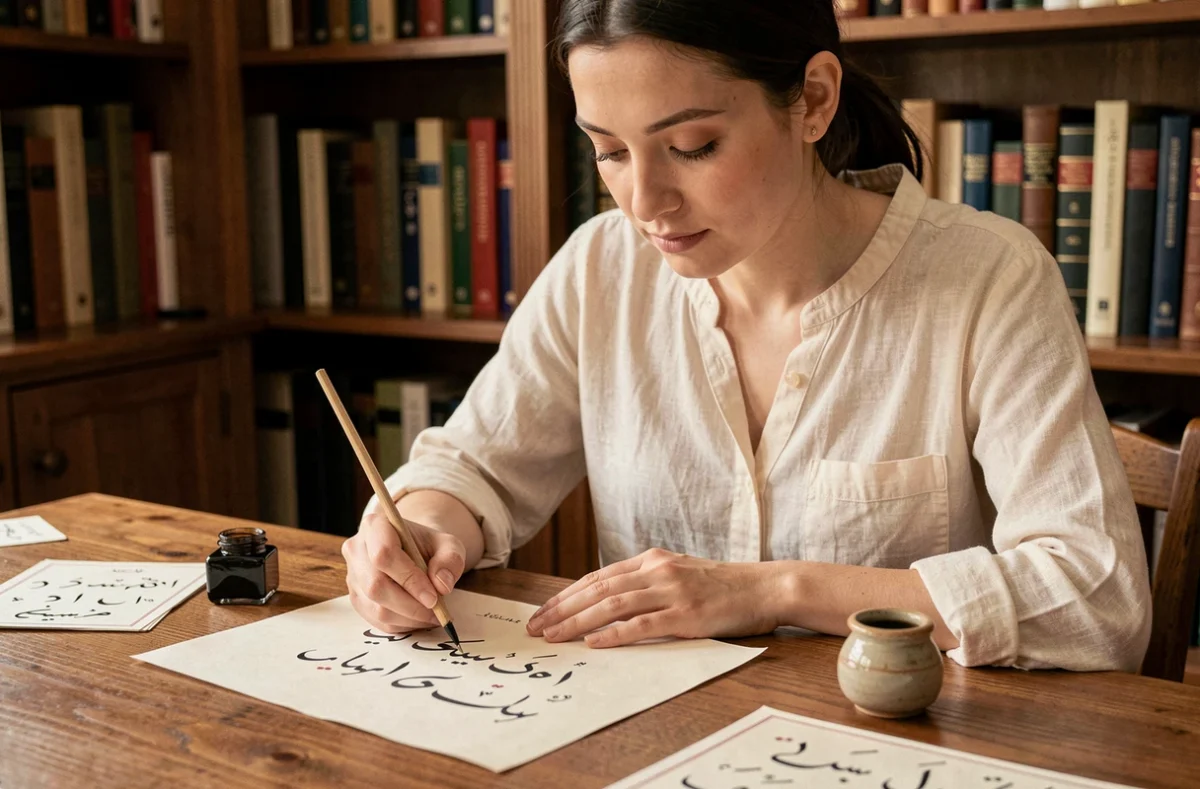
The Arabic alphabet has 28 letters, all of them consonants. This writing system, called an abjad, follows rules that differ from French: it is read from right to left, has no uppercase or lowercase letters, and letters change shape depending on their position in a word. Comparing these differences with the Latin alphabet helps identify the real stumbling blocks for French speakers.
Connecting and non-connecting letters: the first distinction to learn
Most guides present the 28 letters in alphabetical order. This approach obscures a functional distinction that affects how you read: not all letters connect in the same way.
Of the 28 letters, 6 do not connect to the letter that follows them. These letters (alif ا, dal د, dhal ذ, ra ر, zay ز, waw و) connect only to the preceding letter. When they appear in a word, they create a visual break, like a space within the word.
The other 22 letters connect on both sides. A word made up entirely of connecting letters forms one continuous block. A word containing a non-connecting letter is visually split into two or more segments, even though it is still a single word.
Learning to spot the letters of the Arabic alphabet that break the connection makes it possible to segment handwritten or printed words long before you know what they mean. This is a more useful decoding skill than simply memorizing the alphabet.

Comparison table of Arabic letter shape families
Several letters share the same basic shape and differ only in the number and position of their diacritical dots. Grouping these letters by shape family reduces the memorization load.
| Shape family | Letters | Distinction |
|---|---|---|
| ba / ta / tha | ب ت ث | 1 dot below, 2 dots above, 3 dots above |
| jim / ha / kha | ج ح خ | 1 dot below, no dot, 1 dot above |
| dal / dhal | د ذ | No dot, 1 dot above |
| ra / zay | ر ز | No dot, 1 dot above |
| sin / shin | س ش | No dot, 3 dots above |
| sad / dad | ص ض | No dot, 1 dot above |
| ta / dha | ط ظ | No dot, 1 dot above |
| ayn / ghayn | ع غ | No dot, 1 dot above |
| fa / qaf | ف ق | 1 dot above, 2 dots above |
This table covers most visual confusions. Diacritical dots are the only distinguishing feature within each family. An effective exercise is to cover the dots, identify the shape, then reveal them to check the letter.
Letters with no shape family
Some letters have a unique shape: alif (ا), lam (ل), mim (م), ha (ه), nun (ن), waw (و), ya (ي), kaf (ك). They are not easily confused with any other letter, making them simpler to memorize on their own.
Arabic vowels and reading without vowel marks
The Arabic alphabet records only consonants. Short vowels are indicated by small marks (harakaat) placed above or below the letters: fatha for the “a” sound, kasra for the “i” sound, and damma for the “u” sound.
These diacritical marks are omitted from everyday texts. They are consistently retained only in educational texts, the Quran, and classical poetry. The same group of consonants can therefore be read in several ways, depending on the grammatical or lexical context.
For beginners, comparing a fully vowelled text with its unvowelled version shows how much Arabic readers infer through familiarity. Starting with fully vowelled texts is the most reliable way to associate each letter with its actual sound before moving on to everyday reading.
- The three long vowels (alif ا, waw و, ya ي) are letters of the alphabet and appear in the text, whether vowelled or not.
- The three short vowels (fatha, kasra, damma) are added marks that are absent from most written texts.
- Sukūn (the absence of a vowel after a consonant) is also a diacritical mark, often omitted from unvowelled texts.

Four forms for each Arabic letter: isolated, initial, medial, and final
Each letter can have up to four forms depending on its position in a word: isolated, initial, medial, and final. The isolated form serves as a reference, but it rarely appears in actual text.
Variations mainly affect horizontal extensions (the letter’s “tail”) and ligatures with neighboring letters. The central body and dots remain stable. Recognizing this shared graphic core is the key to identifying a letter in any position.
- The 6 non-connecting letters (alif, dal, dhal, ra, zay, waw) have only two forms: isolated and final, which makes them easier to learn.
- The 22 connecting letters have four distinct forms, but the differences between the initial and medial forms are often minimal.
- Handwriting accentuates shape variations compared with digital fonts, making handwriting practice especially useful for visual recognition.
Handwriting and memorizing letter forms
Writing letters by hand engages motor memory in a way that typing does not. Repeating the movements helps reinforce the distinction between visually similar letters, such as ba (ب) and nun (ن), whose medial forms differ slightly.
Recognizing letters does not guarantee that you can read words fluently. The next step is to combine letters into syllables, taking vowels and connecting rules into account. Learning by shape families, distinguishing connecting from non-connecting letters, and then moving on to vowelled texts remains the most logical progression for a French speaker learning Arabic script.