
Cutting a block of meat taken out of the freezer without thawing it beforehand poses a concrete mechanical problem. The muscle fibers, saturated with crystallized water, form a rigid mass that resists standard kitchen knives and can break an ill-suited blade. The issue is less about the force to apply than about the choice of equipment and managing health risks during the operation.
What the cold changes in the structure of meat
A piece of frozen meat is nothing like the same piece fresh. The water contained in the muscle cells transforms into ice crystals that weld the fibers together. The result is a block whose hardness is closer to dense wood than to food.
This rigidity explains why a chef’s knife, even perfectly sharpened, slips or gets stuck. The thin, smooth blade has no grip on the icy surface. Pressing harder does not solve anything: it increases the risk of slipping and injuring oneself or bending the blade irreversibly.
Temperature also plays a direct role in contamination. Recent food safety recommendations emphasize one point: leaving a partially thawed block at room temperature promotes bacterial growth. Working on a completely frozen product with an appropriate tool, or after a controlled thawing in the refrigerator, remains the only reliable approach to avoid warm zones where Salmonella and Campylobacter multiply.
Knowing a method for cutting frozen meat suitable for the type of piece (fillet, poultry block, including bones) helps limit these risks while achieving clean cuts.
Frozen knife, saw, or electric knife: which tool for which block
The equipment makes all the difference. Three categories of tools stand out, each with a specific field of application.
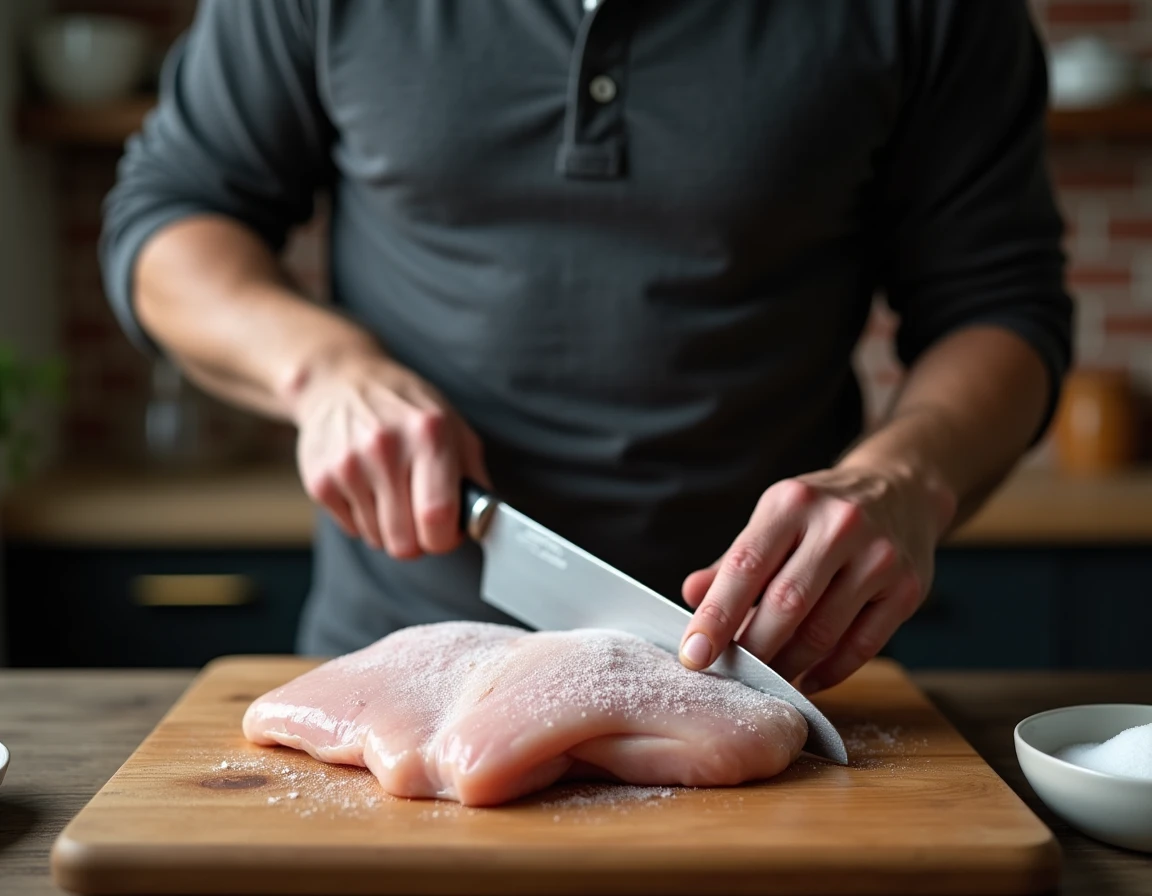
The frozen knife
This is the most accessible tool. Its blade, usually serrated, thick, and rigid, measures between twenty and thirty centimeters. The teeth bite into the ice where a smooth blade slips. Some manufacturers now offer blades with nitrided or ceramic anti-corrosion treatments, designed to withstand the moisture of the cold and maintain their sharpness despite repeated use on hard blocks.
The frozen knife is suitable for reasonably sized portions: a fillet of fish, a slice of ground meat, or a poultry fillet. For a compact block weighing several kilos, the blade reaches its limits.
The electric knife with frozen blades
An electric knife equipped with specific blades for frozen products reduces physical effort. The oscillating motion of the two serrated blades attacks the surface without the user needing to force. It is an intermediate solution that works well on medium blocks.
Field feedback varies on this point: some users achieve clean cuts on frozen chicken, while others find that the blade heats up and slows down on very thick pieces or those containing bones.
The compact band saw
In recent years, home-format butcher band saws have become popular among individuals who buy in bulk or practice BARF for their pets. These machines cut bones and large frozen blocks with a precision that neither the knife nor the electric knife can match.
The investment is heavier and the actual footprint is larger, but for someone who regularly cuts frozen meat blocks weighing several kilos, it is the only tool that does not compromise on cutting quality.
Cutting frozen meat: the technique that protects the blade and fingers
Having the right tool is not enough. The way to position the block and guide the cut determines both safety and the result.
- Stabilize the block on a heavy, non-slip cutting board dedicated to this use. A block that slips on a smooth countertop is the leading cause of cuts.
- Mark the cutting line by lightly pressing the serrated blade against the surface, as one would start a saw cut on wood. The first few centimeters should create a groove that will guide the rest of the movement.
- Use a regular back-and-forth motion without excessive pressure. The serration does the work. Forcing vertically on a frozen knife risks shattering the block into irregular fragments.
- Wear a cut-resistant glove on the hand holding the block. This detail, often overlooked, prevents the majority of domestic accidents related to cutting frozen products.
For very large blocks (packaging of ten kilos, for example), an alternative is to perform a partial thawing in the refrigerator for a few hours, just enough for the surface to soften without the core reaching the critical temperature zone. Cutting then becomes much easier with the frozen knife while remaining within an acceptable health framework.
Animal feeding and BARF: a particular case not to be underestimated
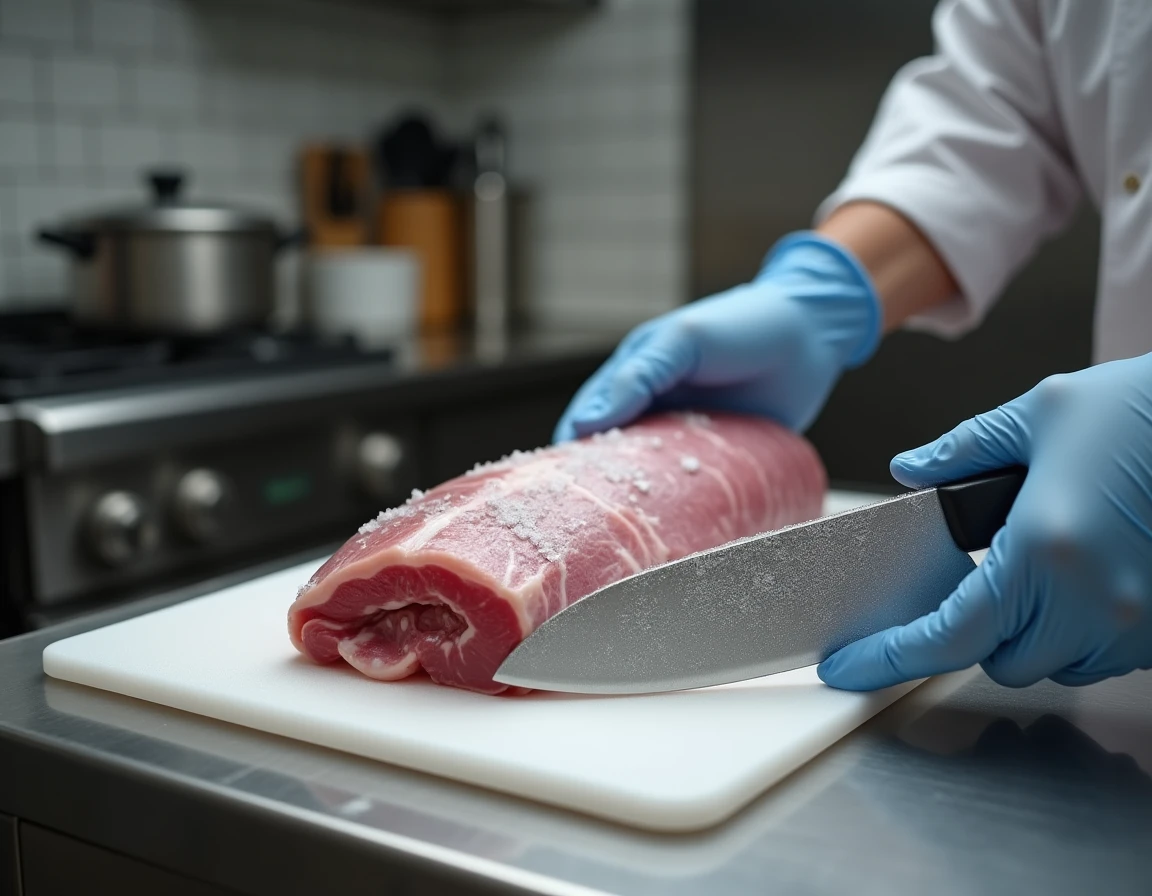
A significant portion of research on cutting frozen meat concerns raw feeding for dogs and cats. Owners who practice BARF often buy blocks of poultry, offal, or meat in bulk and need to portion them themselves.
Recently, veterinarians and canine nutritionists have issued a clearer warning against artisanal cutting without strict hygiene protocols. Field reports indicate cross-contamination in domestic kitchens, particularly by Campylobacter and Salmonella, when the board, utensils, or hands are not rigorously cleaned between cutting for the animal and preparing human meals.
Using a dedicated board, a knife or saw reserved for this use, and disinfecting surfaces after each cutting session is not an excessive precaution. It is a basic sanitary barrier that the convenience of a frozen block to be portioned should not overshadow.
The choice of tool ultimately depends on the frequency and volume of cutting. A frozen knife is sufficient for occasional use on modest portions. An electric knife with suitable blades covers most common needs. The compact band saw is only justified for regular cutting of large blocks, but it transforms a chore into a quick and clean operation.